
UN Update: Lithium/Sodium Vehicle Battery Transport (2023)
Introduction
Shipping electric vehicles from China requires careful attention to evolving regulations. The United Nations Sub-committee of Experts on the Transport of Dangerous Goods (UN TDG) has concluded the 2021-2022 biennium. The revisions, to be incorporated into the upcoming 23rd revised edition of the UN Model Regulations, introduce significant and clarifying changes to the international transport rules for new energy vehicles, including electric cars, scooters, and bicycles.
This notification aims to assist our clients and partners in proactively understanding and adapting to these forthcoming mandatory requirements, ensuring smooth export, booking, declaration, and transportation processes in full compliance.
Key Changes in Classification
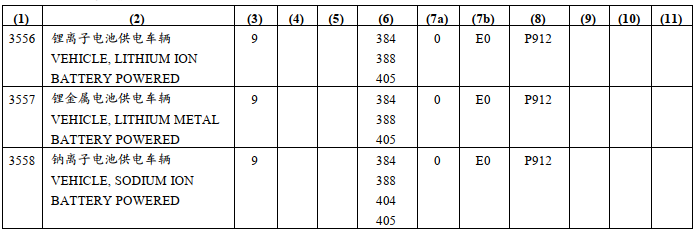
The most critical amendment is the discontinuation of the blanket classification of all battery-powered vehicles under a single entry, UN 3171. The new regulations mandate a more granular classification based on the specific battery chemistry installed in the vehicle:
| New UN Number | Proper Shipping Name | Battery Type | Previous Classification |
|---|---|---|---|
| UN 3556 | VEHICLE, LITHIUM ION BATTERY POWERED | Lithium-ion Batteries | Was under UN 3171 |
| UN 3557 | VEHICLE, LITHIUM METAL BATTERY POWERED | Lithium metal Batteries | Was under UN 3171 |
| UN 3558 | VEHICLE, SODIUM ION BATTERY POWERED | Sodium-ion Batteries | Was under UN 3171 |
| UN 3171 | BATTERY-POWERED VEHICLE or EQUIPMENT | Only: Wet batteries, Sodium metal batteries, or Sodium alloy batteries | Scope narrowed |
Implications for Logistics Operations
Booking & Documentation:
For preparing shipping instructions, the Shippers Declaration for Dangerous Goods for air freight, and other transport documents, you must now use the correct new UN number (UN 3556, 3557, or 3558) based on the vehicle's actual battery type. Continued use of the old UN 3171 may lead to booking rejections, documentation non-compliance, or customs delays.
Packing & Handling:
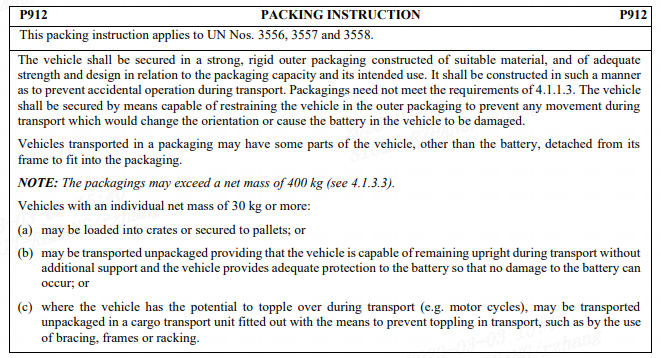
A new Packing Instruction P912 has been introduced specifically for UN 3556, 3557, and 3558. Key requirements include:
- Vehicles must be securely immobilized in a strong, rigid outer packaging to prevent movement, toppling, or damage to the battery during transport.
- The packaging itself is not required to meet the performance test criteria of section 4.1.1.3.
- For vehicles with an individual net mass of 30 kg or more, flexible options are provided, such as crating, securing to pallets, or under specific safety conditions (e.g., the vehicle can remain upright unaided, the battery is adequately protected, or anti-toppling devices are used in the cargo unit), transport without packaging ("unpackaged") may be permitted. Operations must strictly adhere to P912.
Exemptions & Simplifications:
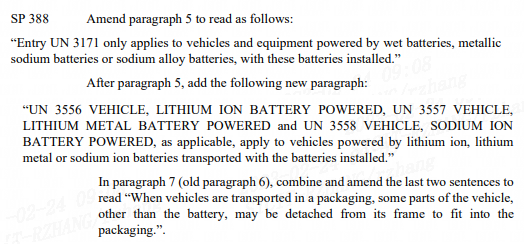
Two new Special Provisions offer operational relief:
- SP 404: Vehicles powered only by sodium-ion batteries (UN 3558) containing no other dangerous goods are exempted from most other provisions of the Regulations if the battery is short-circuited so that it contains no electrical energy (e.g., via a busbar between terminals, easily verifiable).

- SP 405: Vehicles are not subject to the marking or labelling requirements of Chapter 5.2 when they are not fully enclosed by packagings, crates, or other means that prevent ready identification.

Recommendations & Action Plan
- Immediate Product Review: Identify the exact battery chemistry (lithium-ion, lithium metal, or sodium-ion) in your vehicles intended for export.
- Update Internal Systems: Integrate the new UN Numbers and Proper Shipping Names into your product databases, customs documentation, and internal SOPs.
- Communicate with Suppliers: Inform your manufacturing suppliers in China to ensure compliance from the origin, including product packaging and MSDS.
- Consult Your Freight Forwarder: Prior to shipment, confirm the latest booking requirements, documentation, and packing solutions with your hazardous materials specialist. Our team of DG experts is fully versed in the new rules and can provide end-to-end compliant solutions.
For further details or specific shipment advice, please contact your account manager or our Dangerous Goods department.
Date: October 27, 2023