
GHS Rev.10 (2023): Key Updates for Chemical Logistics
Introduction
The Globally Harmonized System of Classification and Labelling of Chemicals (GHS) is the foundational framework for the safe handling, transport, and regulation of chemical products worldwide. The recent publication of GHS Revision 10 (2023) by the United Nations introduces significant updates that directly impact the classification, packaging, marking, labeling, and documentation for the international shipment of chemicals. For importers sourcing goods from China and logistics providers managing these complex supply chains, understanding these changes is not just a regulatory formality—it is a critical operational necessity to ensure safety, compliance, and the uninterrupted flow of goods. This article distills the key amendments from an international logistics perspective, focusing on implications for sea and air transport of dangerous goods.
Summary of Major Revisions and Logistics Impact
The revisions in GHS Rev. 10 primarily refine criteria in three hazard classes: Physical, Health, and Environmental. The most substantial changes affect classification, which in turn dictates downstream logistics requirements.
1. Physical Hazards: Enhanced Criteria for Explosives & Desensitized Explosives (New Testing Mandates)
Core Change: The most operationally significant update is for Desensitized Explosives (Chapter 2.17). The classification logic (Figure 2.17.1) now mandates new testing for sensitivity and thermal stability in addition to existing criteria for explosive potential and corrected burning rate. Substances must be tested per the UN Manual of Tests and Criteria.
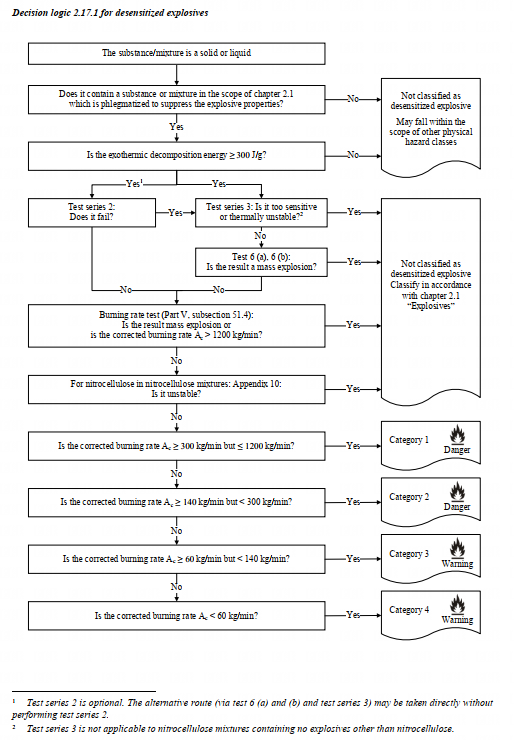
Logistics Impact: This change may lead to re-classification of some substances. A product previously shipped under a different dangerous goods class (e.g., as a flammable liquid) may now be classified as a desensitized explosive. This has a domino effect:
- Packaging: Requires UN-specification packaging certified for explosives (Class 1).
- Documentation: The Proper Shipping Name, Class/Division, and Packing Group on the Dangerous Goods Declaration (DGD) / Shipper's Declaration will change.
- Segregation & Stowage: Stricter segregation codes under the IMDG Code (Sea) and IATA DGR (Air) apply. On vessels, this affects cargo hold compatibility and on-deck stowage requirements.
- Regulatory Approval: Shipments may require additional permits or pre-approvals from carriers and port authorities.
2. Health Hazards: Formal Adoption of Non-Animal Testing Methods
Core Change: Chapters on Serious Eye Damage/Eye Irritation (3.3) and Respiratory or Skin Sensitization (3.4) now explicitly incorporate data from non-animal (alternative) test methods, including predictive computer models (SAR/QSAR), expert systems, and read-across, as valid evidence for classification.
Logistics Impact:
- Classification Stability: While not directly changing transport classes for many substances (e.g., skin sensitisers often fall under Class 9, UN3082), it ensures the classification basis is modernized. Accurate classification is the first and most critical step in compliant logistics.
- Labeling/Marking: Ensures the GHS pictograms and hazard statements on inner/consumer packaging and outer transport packages are correct, which is essential for safe handling throughout the supply chain.
3. Environmental Hazards & Annex Updates
Core Change: Revisions to Annex 9 (Aquatic Hazard) now include specific guidance for organometallic compounds and the application of M-factors for metals and inorganic metal compounds.
Logistics Impact: For substances classified as Environmentally Hazardous (Aquatic Pollutant), this provides clearer criteria. This affects:
- Marking: The "Marine Pollutant" mark on cargo transport units and packages.
- Documentation: The Marine Pollutant entry on the DGD and Bill of Lading.
- Emergency Response: Accurate information for spill response plans.
4. Critical Updates to Hazard & Precautionary Statements (Annex 3)
Core Change: New and modified hazard (H) and precautionary (P) statements, including the new combined statement H315+H319 and updated P-codes for respiratory sensitizers (e.g., addition of P233, P260).
Logistics Impact: This is crucial for Safety Data Sheets (SDS) and container/package labeling. Logistics personnel and handlers rely on clear, standardized symbols and phrases for safe handling, storage in transit, and emergency response. An updated SDS (Sections 2, 14, 15) is a mandatory transport document.
Actionable Steps for Importers & Logistics Partners
- Review Classifications: Immediately initiate a review of the GHS classification for all products supplied from China against Rev. 10 criteria, paying special attention to desensitized substances and metal/organometallic compounds.
- Update Safety Data Sheets (SDS): Demand updated, Rev. 10 compliant SDS from your Chinese suppliers. The SDS is the source document for all transport classifications.
- Verify Transport Classification: With your accredited dangerous goods advisor or third-party lab, confirm the correct UN Number, Proper Shipping Name, and Primary/Subsidiary Classes according to IMDG/IATA, which are harmonized with GHS.
- Audit Packaging & Labeling: Ensure all inner and outer packaging, including GHS labels and transport hazard placards/marks, reflect any potential re-classifications.
- Communicate with Your Freight Forwarder: Proactively provide updated documentation and discuss any classification changes with your logistics provider well before booking. This allows for proper carrier selection, booking approval, and contingency planning.