
A Guide to Safe and Compliant Transport of Fireworks via Ocean Freight
—— A Focus on Shipping Fireworks from China
Introduction
The recent tragic accident at a fireworks factory in Liuyang, China, which resulted in significant casualties, serves as a stark and somber reminder: safety in the fireworks supply chain is non-negotiable. Every single link, from production to the final point of transport, is critical. This is especially true for international ocean freight, a complex logistical operation involving multiple stakeholders. For international buyers sourcing goods from China, understanding the stringent regulations governing the maritime transport of dangerous goods like fireworks is paramount to ensuring a safe, compliant, and successful supply chain. This article outlines the core requirements, stakeholder responsibilities, and the serious legal implications of non-compliance.
Part 1: Fundamental Requirements for Ocean Transport of Fireworks
Fireworks are classified as Class 1 Explosives under the International Maritime Dangerous Goods (IMDG) Code. Common UN numbers include UN0335 (1.3G) (e.g., large display shells), UN0336 (1.4G) (e.g., consumer fireworks), and UN0337 (1.4S) (e.g., toy caps). Incorrect classification is a primary cause of unsafe stowage and a severe accident risk.
1. Packaging, Marking, and Labeling
Packages must be robust, intact, and clearly marked with the correct:
- UN Number (e.g., UN0336)
- Proper Shipping Name ("FIREWORKS")
- Class Label (1.3G, 1.4G, or 1.4S)
- Explosive Subsidiary Risk Label (where applicable)
Damaged packaging or illegible markings are grounds for rejection at the container loading site.
2. Stowage and Segregation Onboard
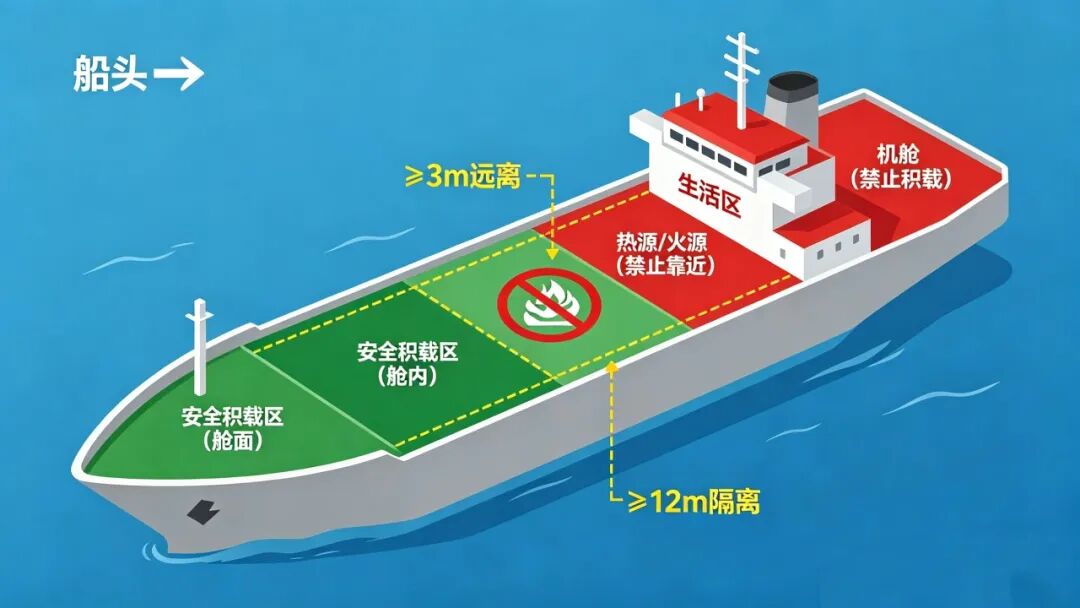
Safe stowage is governed by strict IMDG Code rules, which mandate:
- Location: Away from living quarters, engine rooms, sources of heat, ignition, and vibration.
- Distance: Minimum 3 meters horizontally from heat sources. Minimum 12 meters from living quarters and life-saving appliances.
- Segregation: Based on Compatibility Groups (A to S). Different groups may require "separated from" or "away from" stowage.
- Seasonal Considerations: Special attention to temperature control is required in hot climates.
- Firefighting: Appropriate and accessible fire-fighting equipment must be available near the stowage location.
3. Documentation and Declaration (Key for Shippers)
Accurate and complete documentation is the foundation of legal and safe transport. Mandatory documents typically include:
- Material Safety Data Sheet (MSDS) / Safety Data Sheet (SDS): Must detail composition, properties, and hazards.
- Certificate of Approval for Transport Packaging: Proof that packaging has passed performance tests.
- Container Packing Certificate (CPC): A legally binding declaration signed by a certified packer/checker confirming the container was properly packed, secured, and checked. The CPC is a critical control document.
- Dangerous Goods Declaration (DGD): Submitted by the freight forwarder or carrier's certified Dangerous Goods Declaration Officer to the maritime authorities and the vessel operator well before loading (usually 24 hours).
4. Mandatory Qualifications
- Vessel: Must hold a valid Certificate of Fitness specifically for carrying Class 1 Explosives.
- Carrier/Shipping Line: Must hold a valid license for the transport of dangerous goods.
- Personnel: The Declaration Officer (who prepares the DGD) and the Packer/Checker (who supervises loading and signs the CPC) must hold valid certifications.
Part 2: The Chain of Responsibility
Safety is a shared responsibility across a chain of five key parties. A failure by any one can compromise the entire operation.
Shipper/Consignor
The primary source of truth. Must:
- Possess valid manufacturing/trading licenses.
- Appoint a qualified carrier/forwarder.
- Accurately disclose the full dangerous nature of the goods.
- Provide a correct SDS.
- Ensure proper packaging, marking, and labeling.
- Initiate the dangerous goods booking and declaration process truthfully.
Carrier/Freight Forwarder
The transport controller. Must:
- Hold valid dangerous goods transport authorization.
- Verify the vessel's Certificate of Fitness.
- Submit an accurate DGD to authorities.
- Audit the shipper's provided information.
- Refuse cargo that does not meet safety or documentation requirements.
Vessel
The physical carrier. Must:
- Have a valid Certificate of Fitness for Class 1.
- Maintain fire-fighting and emergency equipment.
- Be in a seaworthy and cargoworthy condition.
- Implement anti-static measures.
- Execute stowage and segregation plans precisely.
Dangerous Goods Declaration Officer
The information gatekeeper. Must:
- Hold valid certification.
- Declare accurately and timely (e.g., 24-hour pre-loading rule).
- Verify the authenticity of supporting documents (SDS, packaging certificates).
- Never engage in misdeclaration, false declaration, omission, or fraudulent declaration.
Container Packer/Checker
The on-site verifier. Must:
- Hold valid certification.
- Supervise the entire stuffing operation.
- Inspect packages for integrity.
- Verify marks and labels are correct and legible.
- Ensure stowage and securing inside the container complies with the IMDG Code.
- Complete the CPC truthfully.
Part 3: Legal Framework and Severe Consequences of Non-Compliance
The regulatory framework is multi-layered, combining international codes (IMDG Code), national laws, and maritime safety regulations. Compliance is not optional; it is a legal imperative with serious consequences.
Critical Legal Warning: The Criminal Risks of Misdeclaration
Misdeclaring, concealing ("under-declaring"), or stuffing fireworks within general cargo is not a "shortcut"—it is a criminal act that endangers public safety.
- Administrative Penalties: Authorities can impose significant fines.
- Criminal Liability: Such acts may constitute the crime of "Endangering Public Safety by Dangerous Means." A precedent was set in 2018 by the Shanghai Hongkou District People's Court. In a case involving the concealed export of fireworks, the principal fireworks manufacturer was sentenced to five years imprisonment. The involved freight forwarder, customs broker, and truck driver received sentences of four and a half years. All confiscated fireworks were seized.
- Legal Basis: Judicial interpretations specify that acts like consigning dangerous goods as general cargo, if done knowingly while disregarding obvious hazards, can lead to prosecution for endangering public safety.
Conclusion
For international buyers, ensuring your supplier and their logistics partners adhere to these protocols is a critical part of supply chain risk management. Due diligence in vetting the compliance of the entire transport chain is essential. One act of negligence can lead to catastrophe, while rigorous compliance ensures safety. Let us commit to a "zero-tolerance" policy towards hazards and a "zero-error" standard in every operational step to safeguard maritime transport.
Disclaimer: This guide provides an overview of fireworks transport requirements based on the IMDG Code and relevant regulations. Always consult your freight forwarder, certified dangerous goods personnel, and the latest IMO regulations for specific compliance needs. Regulations are subject to amendment.