
Ensuring Chemical Safety and Compliance: A Guide to Mandatory Marking and Labeling Standards for Dangerous Goods Packaging in China for Export
Introduction
The international transportation of chemicals and dangerous goods—whether by sea or air—is not merely a logistical operation but a highly regulated activity governed by a complex framework of international, national, and destination country regulations. For international buyers sourcing products from China, understanding China's domestic standards for the classification, packaging, and identification of dangerous goods is a critical first step in ensuring smooth customs clearance, safe transport, and fulfilling downstream compliance responsibilities. The mandatory standard "HJ 1276-2022 Technical Specification for Setting Identification Signs of Hazardous Waste" issued by China's Ministry of Ecology and Environment is a cornerstone of this regulatory system, specifically for the management of "hazardous waste."
Core Regulation and Key Concepts
This standard is enacted under the authority of China's Law on the Prevention and Control of Environmental Pollution by Solid Waste. It mandates that all entities generating, collecting, storing, utilizing, or disposing of hazardous waste must affix standardized identification signs on their containers, packages, and corresponding facilities. It is crucial to distinguish that "hazardous waste" here typically refers to waste generated from industrial processes, listed as possessing hazardous properties such as corrosivity, toxicity, flammability, or reactivity. For new products in international trade (e.g., chemical raw materials), their transport packaging must be marked and labeled per the International Maritime Dangerous Goods (IMDG) Code or IATA Dangerous Goods Regulations (DGR). HJ 1276-2022 governs the domestic identification requirements for these substances once they become "waste" at the end of their lifecycle. Understanding this distinction helps buyers clarify their suppliers' compliance obligations at different stages of the supply chain.
Detailed Overview of the Three Core Identification Signs
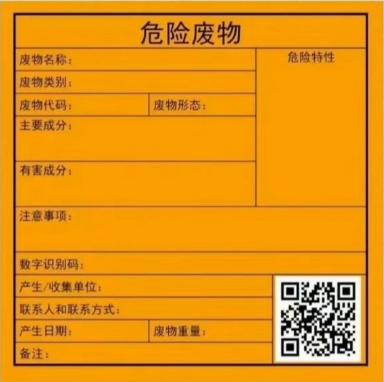
The standard defines three mandatory identification signs, creating a comprehensive visual management system from the smallest packaging unit to the storage facility:
| Identification Sign | Purpose & Key Information |
|---|---|
| Hazardous Waste Label "Safety Data Sheet for the Package" |
Affixed to: Directly on hazardous waste containers (bulk bags, steel drums, IBCs). Key Information:
|
| Hazardous Waste Storage, Utilization, and Disposal Facility Sign "Site's Warning Sign" |
Posted at: Entrances to hazardous waste warehouses, treatment plants, disposal sites. Features: Yellow triangular warning symbol, facility type (e.g., "Hazardous Waste Storage Facility"), operating entity, responsible person's contact details. |
| Hazardous Waste Storage Zoning Sign "Warehouse's Navigation Map" |
Located in: Inside large hazardous waste storage warehouses. Displays: Floor plan showing waste types in different zones, specific locations, emergency equipment placement, and exits. Essential for safe operations and emergency response. |
Implications for International Logistics and Procurement
| Area | Key Implication |
|---|---|
| Evidence of Source Compliance | Well-maintained hazardous waste identification proves a supplier's robust internal management system and compliance awareness during EHS audits. Demonstrates waste is correctly classified before leaving the factory gate. |
| Prerequisite for Compliant Transport Packaging | Under IMDG Code, packages for dangerous goods must be properly cleaned and have old markings removed. Properly labeled internal waste packages are the foundation for compliant transport packaging. |
| Clarifies Liability Boundaries | "Generator" information identifies the legal entity responsible for waste at origin. When waste from multiple suppliers is consolidated, the label points to the "Collector," clarifying liability during consolidation. |
| Enhances Safe Handling and Transshipment | Clear Chinese/pictorial identification alerts port and warehouse personnel during stuffing container operations, mitigating mishandling risk. |
Conclusion and Recommendations
HJ 1276-2022 represents a significant step forward in standardizing and visualizing hazardous waste management in China. For international buyers, understanding this standard is not about direct implementation, but rather to:
- Incorporate it as a key EHS audit point during supplier evaluations.
- Specify in contracts and agreements that suppliers must manage and label hazardous waste generated in their processes according to this standard.
- Enable more professional communication with suppliers regarding their compliance documentation and site photos.