
Navigating the Nuances: A Case Study on the Exemptions for Life-Saving Appliance (UN 2990) Packaging in International Maritime Transport
—— A Focus on Shipping Liferaft from China
Abstract
In the realm of international dangerous goods transportation, the depth of regulatory understanding directly impacts compliance costs and operational efficiency. This article analyzes a real-world enforcement case from China Customs, delving into the specific packaging exemptions for "Life-Saving Appliances, Self-Inflating" (UN 2990) under the International Maritime Dangerous Goods (IMDG) Code. The objective is to provide global purchasers, shippers, and logistics practitioners with a clear, professional perspective on these regulatory details, helping to prevent potential customs clearance delays and administrative penalties arising from information asymmetry or interpretive discrepancies.
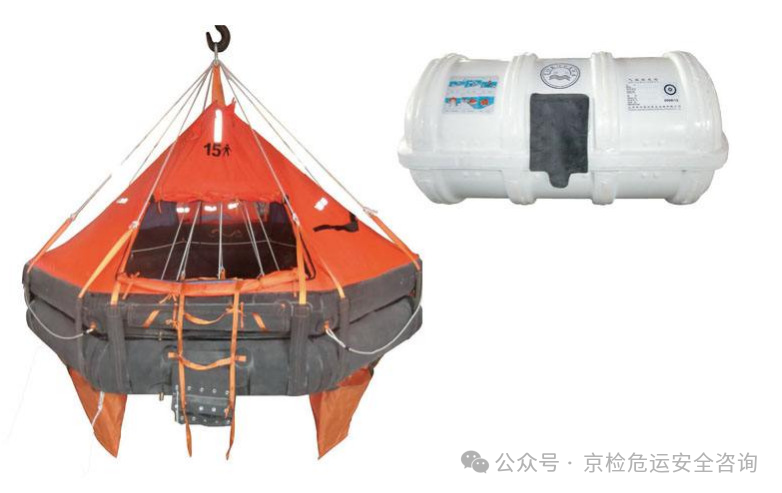
Case Review: A "Unnecessary" Penalty?
Recently, the Shanghai Maritime Safety Administration in China imposed an administrative penalty on a shipment of 30 life rafts, levying a fine of RMB 10,000. The legal basis for enforcement was that the goods were classified as Class 9 Dangerous Goods (UN 2990), but the shipper failed to present the "Certificate for Use Appraisal of Export Dangerous Goods Packaging" as issued by China Customs, thereby violating China's "Law on Import and Export Commodity Inspection."
On the surface, this appears to be a standard case of non-compliance with dangerous goods packaging regulations. However, a deeper analysis of the specific provisions within the IMDG Code reveals a critical point for debate.
Professional Regulatory Analysis: The Exemption Provisions for UN 2990 under the IMDG Code
The core issue is whether UN 2990 (Life-Saving Appliances, Self-Inflating) is mandatorily required to use "Dangerous Goods Packaging" – commonly referred to as "performance packaging" – that complies with the performance standards of IMDG Code, Section 6, under specific conditions.
According to IMDG Code (Amendment 40-20):
UN Entry and Special Provision 296
UN 2990 is governed by Special Provision 296. This provision explicitly states that life-saving appliances contained in a robust outer packaging are not subject to the provisions of the IMDG Code if they meet conditions such as a total mass not exceeding 40 kg, containing only limited quantities of Class 2.2 gases (capacity ≤120 mL per receptacle), and no other major dangerous goods. This constitutes the first layer of exemption.
Packing Instruction P905
This is the focal point of contention in this case. Packing Instruction P905 clearly states:
- "Any suitable packaging may be used, provided the packaging need not conform to the provisions of Section 6."
- "When the life-saving appliance is designed to contain or be contained in a robust, weatherproof casing (e.g., lifeboats, liferafts), it may be transported unpackaged."
Professional Interpretation
The mandatory packaging requirements in the IMDG Code derive their legal basis from Section 4.1.1.3 – "packagings shall be of a design type which has been successfully tested" (implying the need for a "performance test certificate" and an official "use appraisal certificate"). Packing Instruction P905, through the explicit phrase "need not conform to the provisions of Section 6," substantively exempts this mandatory requirement.
This means that for life rafts fitting the description in P905, their transport packaging does not require specific performance testing or official "dangerous goods packaging" certification. The key document required instead is typically the Product Type Approval Certificate or Certificate of Conformity issued by a recognized classification society (e.g., ABS, DNV, CCS), verifying that the design meets safety standards.
Conclusion and Recommendations for International Purchasers
This case highlights the complex hierarchy of rules in international logistics, particularly for chemical/dangerous goods transport, between "what it is" and "how it must be handled."
- What it is: A life raft (UN 2990) is indeed a listed Class 9 Dangerous Good.
- How it must be handled: Its transport packaging requirements, however, have a clearly defined exemption pathway under the IMDG Code, distinct from ordinary dangerous goods.
Key Recommendations:
- Always consult the specific Special Provisions and Packing Instructions for your UN number, not just the hazard class.
- Understand that classification as a dangerous good does not automatically mandate full performance packaging – exemptions exist.
- Work with a qualified dangerous goods logistics partner who understands these nuanced regulatory distinctions to avoid unnecessary compliance costs and penalties.
- For UN 2990, the appropriate document is typically a type approval certificate from a recognized classification society, not a dangerous goods packaging use appraisal certificate.
Disclaimer: This guide provides general information based on IMDG Code Amendment 40-20. Always consult your freight forwarder and certified dangerous goods personnel for specific cargo requirements. Regulations are subject to change.