
A Guide for International Shippers: New IMDG Code Regulation for Lithium-ion Battery Powered Vehicles – Transition from UN 3171 to UN 3556
Important Update on Sea Transport Regulations for Lithium-ion Battery Powered Vehicles
1. Regulatory Change: Introduction of UN 3556
The International Maritime Dangerous Goods (IMDG) Code, Amendment 42-24, introduces a significant change for the maritime transport of battery-powered vehicles. The previous entry, UN 3171 BATTERY-POWERED VEHICLE or BATTERY-POWERED EQUIPMENT, has been subdivided.
The new entry, UN 3556 VEHICLE, LITHIUM ION BATTERY POWERED, now specifically covers all vehicles powered by rechargeable lithium-ion batteries. Equipment powered by other battery types (e.g., lead-acid) or battery-powered equipment that is not a vehicle falls under different regulations. This change aims to align classification with practical operational and safety requirements.
2. Key Differences & Operational Implications
Packing Instruction:
- UN 3171: Had no assigned packing instruction.
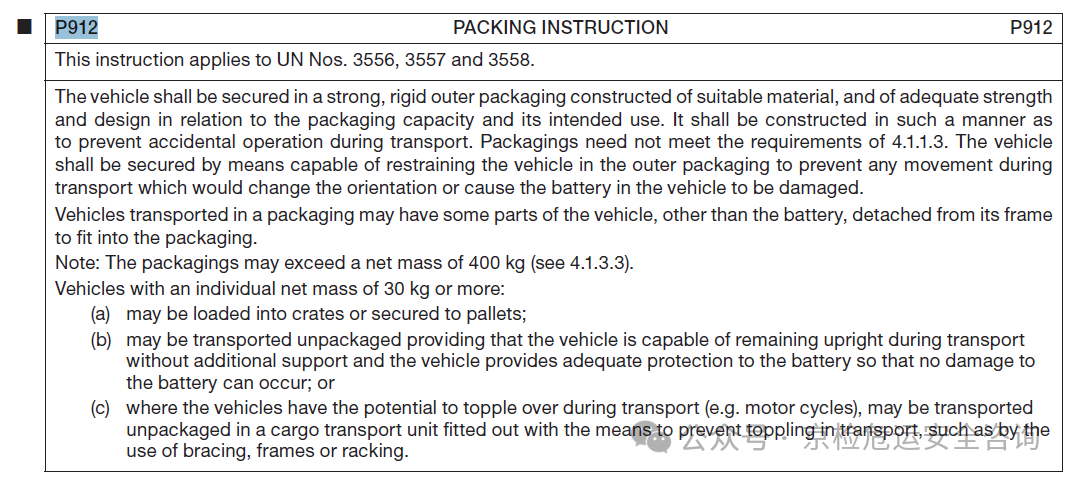
- UN 3556: Assigned to Packing Instruction P912. Key points include:
- The vehicle must be secured in a strong, rigid outer packaging.
- Vehicles with a net mass of 30 kg or more may be transported unpackaged if they can remain upright during transport and adequately protect the battery, or may be crated/palletized.
- Crucially, packagings do not need to meet the performance testing requirements for dangerous goods packages (i.e., they are not "UN specification packages").

Marking, Labeling, and Placarding:
- For unpackaged vehicles (e.g., cars, motorcycles):
- No hazard labels or marks are required on the vehicle itself.
- However, the cargo transport unit (CTU) must bear the proper shipping name or an orange plate marked "UN 3171" on at least two sides.
- For packaged vehicles (e.g., electric bicycles, scooters in boxes):
- Package Marking: Each package must show: UN Number (UN 3556), Proper Shipping Name, and Class 9 hazard label (Model 9A).
- CTU Placarding: The container must be placarded with a Class 9 placard (Model 9).
- Overpack Marking: If units are consolidated into an overpack, the outer packaging must be marked with "OVERPACK".
3. Implementation Timeline & Transition Period
- Transition Period (2025): Both UN 3171 and UN 3556 are acceptable for use under the IMDG Code in 2025. However, the actual use of UN 3556 for a shipment is subject to acceptance by all parties in the transport chain: the originating port (China Customs), the ocean carrier, any transshipment ports, and the destination country's authorities. If any party does not accept it, UN 3171 must be used. Clarification with your freight forwarder and carrier before booking is essential.
- Mandatory Date (Effective January 1, 2026): From this date forward, the use of UN 3556 is mandatory for the sea transport of applicable lithium-ion battery powered vehicles under the IMDG Code.
4. Actionable Recommendations for International Buyers
- Contractual Clarity: Specify in your purchase orders/contracts with Chinese suppliers that for shipments with Bill of Lading date on or after January 1, 2026, all packaging, documentation, and markings must comply with IMDG Code Amendment 42-24 (UN 3556).
- Proactive Communication: For shipments in 2025, engage your logistics provider early to verify the acceptance of UN 3556 along the entire route to avoid delays.
- Documentation Review: Ensure consistency among all shipping documents (DGD, packing list, MSDS) regarding the UN number, proper shipping name, and the physical condition of the goods (packaged/unpackaged).
Conclusion
This regulatory update enhances safety and operational clarity in global logistics. By understanding the transition from UN 3171 to UN 3556, we can work together to ensure compliant and efficient supply chains.
Disclaimer: This guide provides general information based on IMDG Code Amendment 42-24. Always consult your freight forwarder and certified dangerous goods personnel for specific cargo requirements. Regulations are subject to change.