
Understanding GHS Labels: A Critical Guide for International Chemical Transport
Purpose: To explain the function, components, and compliance requirements of GHS labels in the context of international freight transport (air/sea) for chemical products sourced from China.
Introduction: The "First Line of Defense" in Your Supply Chain
In the complex world of international logistics, the safe and compliant transport of chemical goods is paramount. Many chemicals possess inherent hazards—such as flammability, toxicity, or corrosivity—that are not immediately apparent when the product is securely packaged. A clear, standardized system for hazard communication is essential to ensure the safety of everyone handling these goods throughout the supply chain, from warehouse personnel and freight forwarders to vessel operators and end-users.
The Globally Harmonized System of Classification and Labelling of Chemicals (GHS) provides this universal language. The GHS label, affixed to the external packaging or container of a chemical product, is a critical "first line of defense." Its purpose is to instantaneously communicate the dangers present and the necessary precautions, enabling anyone who encounters the package to "recognize the hazard and take appropriate action."
Core Components of a GHS Label: What Each Element Tells You
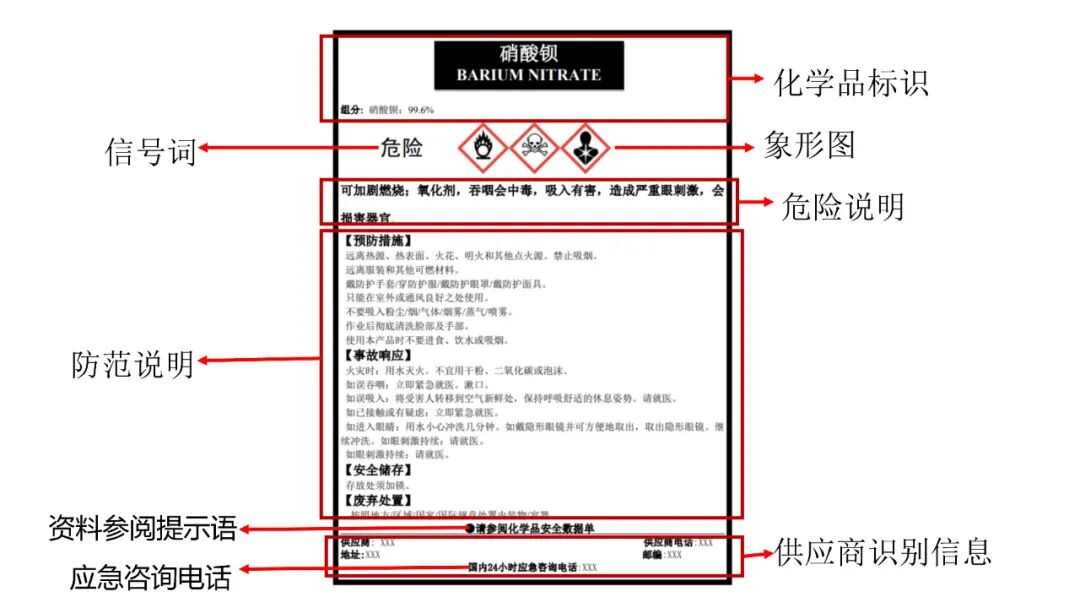
A compliant GHS label is not a random collection of symbols and text; it is a structured document with mandatory elements. Understanding these elements is key to ensuring safe handling and regulatory compliance. A complete GHS label must include:
| Component | Description |
|---|---|
| Product Identifier | The chemical name(s) matching the Safety Data Sheet (SDS), typically in both English and the local language (e.g., Chinese). This is prominently displayed at the top of the label. |
| Signal Word | Indicates the relative severity of the hazard. • "Danger" is used for more severe hazard categories. • "Warning" is used for less severe categories. Note: If "Danger" is used, "Warning" is omitted. |
| Hazard Statements (H-codes) | Standardized phrases describing the nature and degree of the hazard. Each statement has a unique code (e.g., H224: "Extremely flammable liquid and vapor"). |
| Precautionary Statements (P-codes) | Phrases recommending measures to minimize or prevent adverse effects from exposure, improper storage, or handling. They are categorized as Prevention, Response, Storage, and Disposal (e.g., P210: "Keep away from heat, hot surfaces, sparks, open flames, and other ignition sources. No smoking."). |
| Pictograms | A black symbol on a white background within a red diamond-shaped border. The GHS system uses nine standard pictograms (e.g., flame, skull and crossbones, corrosion symbol) to convey specific hazard information at a glance. |
| Supplier Identification | The name, address, and contact details of the manufacturer or supplier. |
| Emergency Contact Number | A 24-hour emergency phone number for chemical accident consultation. For chemicals imported into China, at least one in-country (China) emergency number is required. |
| Reference to the SDS | A statement directing the user to consult the Safety Data Sheet for comprehensive information. |
| Hazardous Chemical Information Code (China-specific) | A QR code required by China's GB 15258 standard (under revision) that links to the chemical's hazard information in the national registry system. This is a critical compliance item for goods sourced from and shipped within China. |
The Label Creation Process: Ensuring Compliance from Source to Shipment
For international buyers, understanding that your supplier follows a rigorous process to generate these labels is crucial for supply chain integrity. The key steps involve:
- Determining Hazard Classification: The chemical is rigorously classified according to GHS criteria (physical, health, environmental hazards).
- Selecting Label Elements: Based on the classification, the appropriate pictograms, signal words, hazard statements (H-codes), and precautionary statements (P-codes) are selected from the official GHS annexes.
- Layout Design & Information Consolidation: The required elements are arranged in a standard layout. Redundant information is omitted to ensure clarity.
- Incorporating Mandatory Information: Supplier details, the emergency contact, the SDS reference, and the Hazardous Chemical Information Code (QR code) are added.
- Final Review & Affixing: The completed label is reviewed for accuracy and completeness before being applied to the outer packaging.
Why This Matters for Your International Shipment
| Aspect | Importance |
|---|---|
| Regulatory Compliance | Both IATA (air) and IMDG Code (sea) regulations for dangerous goods transport mandate or strongly align with GHS labeling principles. Non-compliant labels can lead to cargo rejection, delays, fines, or even the refusal of shipment by carriers. |
| Safety | Correct labels are the primary tool for safe handling, stowage, and segregation of hazardous materials during transport. They inform emergency responders in case of an incident. |
| Supply Chain Efficiency | Accurate labeling prevents mishandling, repackaging, and documentation rework at transshipment hubs, ensuring your cargo moves smoothly to its destination. |
Key Takeaway for International Buyers
When sourcing chemical products from China, it is imperative to verify that your supplier provides fully compliant GHS labels, including the China-specific Hazardous Chemical Information Code (QR code) where applicable. This is not merely a paperwork exercise; it is a fundamental requirement for the legal, safe, and efficient transportation of your goods. Always request a sample label or a copy for review as part of your supplier qualification and pre-shipment documentation check.